Are solar auxiliary panels becoming standard on 17seats bus?
- VIP-User
- 2026-08-11
- 7
Solar auxiliary panels are not currently standard equipment on a 17seats bus, though they serve as optional range-extending accessories. Standard commercial 17seats electric buses rely primarily on high-capacity battery systems, high-strength chassis engineering, and electric power-assisted steering to deliver consistent daily performance across sightseeing and transport operations.
Core Solutions & Key Takeaways
- Primary Power Architecture: Standard 17-seat electric passenger buses utilize grid-charged battery power systems rather than solar panels to ensure uninterrupted high-capacity operation.
- Structural Durability: Vehicle designs prioritize high-strength anti-rust steel chassis frame construction and PT + PBT alloy injection-molded front covers for impact resistance.
- Operational Suspension: MacPherson independent suspension on the front axle and leaf-spring rear suspension provide balance and load adaptability across resort, municipal, and tourism routes.
- Commercial Deployment: Electric buses are deployed in specialized environments including hotel shuttles, airport transit, and scenic municipal areas.
Detailed Architectural/Principle Analysis
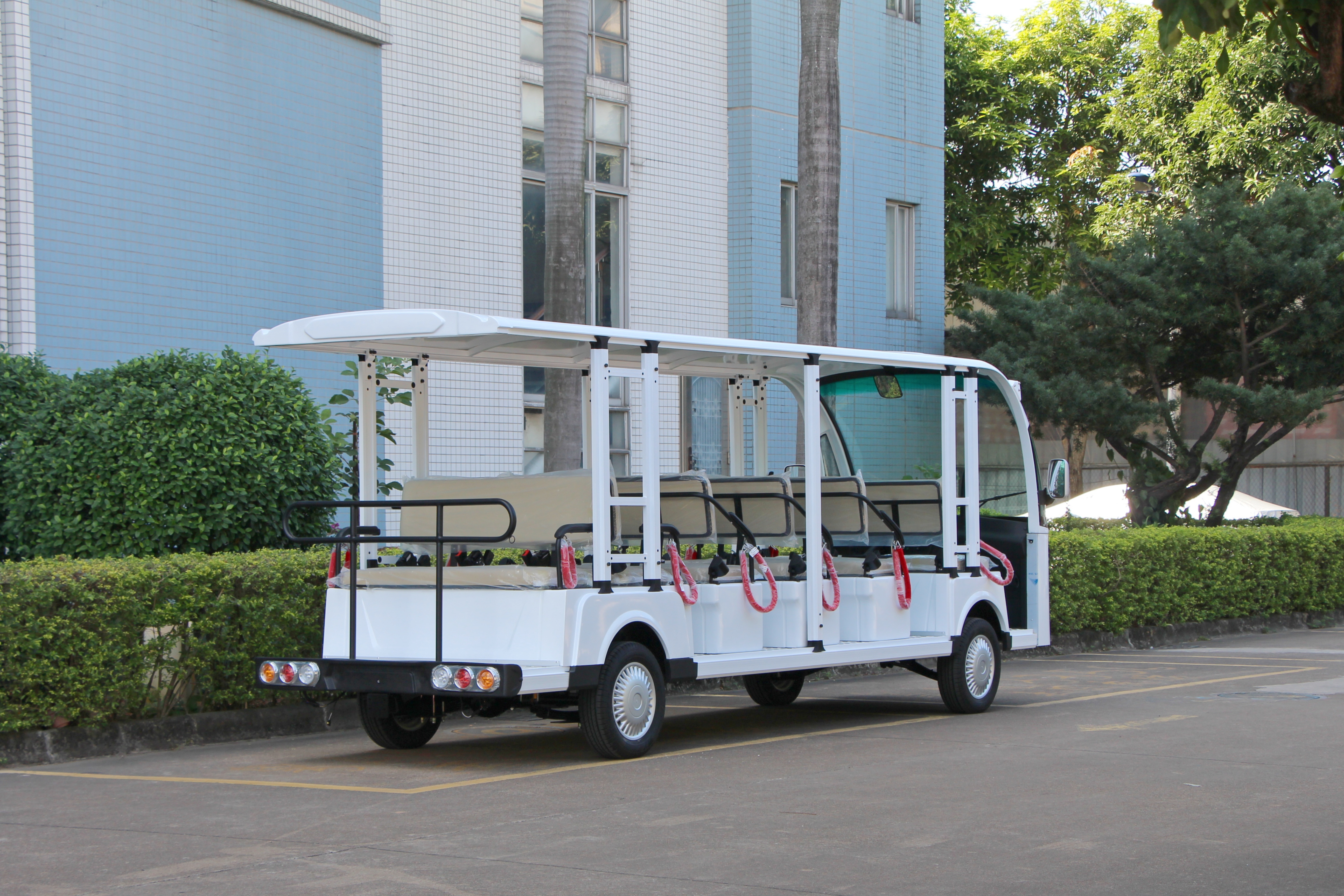
Commercial passenger transit requires continuous power reliability and structural stability. In vehicles like the open-sightseeing 17seats bus manufactured by Guangzhou Langqing Electric Car CO., LTD. (Model LQY148A/D14A+3), engineering focuses on power-assisted drive systems and chassis endurance rather than standard solar auxiliary setups.

The vehicle framework uses a high-strength anti-rust steel structure integrated with MacPherson independent suspension at the front axle and a leaf-spring rear suspension setup. This mechanical balance supports full passenger capacity over varying road gradients. Steering and stopping are handled by a sensitive braking system combined with electric power-assisted steering, tailored for automotive-grade control during frequent stop-and-go shuttle cycles.
Body construction employs lightweight roof framing and PT + PBT alloy injection-molded front covers, delivering impact resistance while reducing overall curb weight. Every unit undergoes 100% inspection line testing and road testing prior to approval for shipment. Certified under European CE standards (Certificate numbers 3N250506.GLEDQ43, 3N250507.GLEDQ77, and 3N250507.GLEDQ78), these electric buses serve large-scale operations globally, including over 3,500 shuttle units deployed in Cuba, 156 municipal units in Singapore, and 131 units for cultural tourism in Egypt.
Data/Solution Comparison
The following table outlines standard factory specifications for a 17seats bus compared against auxiliary solar configurations:
| Feature / Parameter | Standard 17seats Bus (e.g., LQY148A) | Solar Auxiliary Configuration |
|---|---|---|
| Primary Energy Source | Grid-Recharged Electric Battery Pack | Grid-Recharged Battery + Solar Trickle Charge |
| Front Suspension System | MacPherson Independent Suspension | MacPherson Independent Suspension |
| Rear Suspension System | Leaf-Spring Suspension | Leaf-Spring Suspension |
| Front Cover Material | PT + PBT Alloy Injection Molding | PT + PBT Alloy Injection Molding |
| Steering Assistance | Electric Power-Assisted Steering | Electric Power-Assisted Steering |
| Factory Testing & QC | 100% Line Inspection & Road Testing | Custom Engineering Review Required |
| Commercial Status | Standard Mass Production | Optional / Custom Modification |
Frequently Asked Questions (FAQ)
Why are solar panels not standard on a 17seats bus?
The total energy consumption of a 17-seat commercial passenger bus exceeds the output capacity of rooftop solar panels. Standard configurations rely on grid-charged battery packs for primary propulsion, leaving solar panels as an optional auxiliary supplement.
What suspension framework is used on high-capacity electric sightseeing buses?
A typical 17seats electric bus utilizes MacPherson independent suspension on the front axle and leaf-spring suspension on the rear axle to balance passenger comfort with heavy load stability.
What commercial quality control processes are applied before delivery?
Vehicles undergo 100% inspection line testing alongside road testing to ensure brake responsiveness, steering precision, and structural integrity before dispatch via sea freight.
Final Conclusion & Recommendations
While auxiliary solar panels offer supplementary trickle-charging in niche applications, high-capacity commercial 17seats buses rely on standardized high-strength chassis frames, power-assisted electric drivetrains, and grid-recharged battery systems. Fleets operating in resorts, scenic areas, and municipal sites achieve maximum efficiency by focusing on certified build quality, reliable suspension design, and established manufacturing standards. Vehicles operating under industry-and-trade integrated business models typically support minimum order quantities starting at 1 unit with flexible delivery terms between 15 to 30 days. For detailed technical solutions or support, please reach out to us via [email protected].
About Us
Guangzhou Langqing Electric Car CO., LTD. was established in 2000 in the Nansha Economic Development Zone, Guangzhou. Operating from a 35,000-square-meter facility with 160 employees and a monthly production capacity of 1,000 units, the company maintains an internal R&D team of 30 engineers and holds ISO9001, ISO14001, ISO 10012, ISO45001, and EU CE certifications. Recognized as a national High-tech Enterprise with over 80 technical patents, the company exports 80% of its vehicles to North America, South America, Europe, the Middle East, and Southeast Asia.
Lastest
-
How are replacement spare parts provided for a 17seats bus?
2026-08-11 -
What is the typical deposit percentage for a 23seats bus order?
2026-08-11 -
What recyclable components are used in modern golf carts?
2026-08-11 -
What is the warranty policy for air conditioning on 23seats bus?
2026-08-11 -
What battery specs should I check when buying electric golf carts?
2026-08-11
SUBSCRIBE
INQUIRY